As more and more sellers move to marketplaces, building your own online store matters more than ever. Sellers without a direct relationship with their customers will quickly lose their competitive position. REES46 CEO Mikhail Kechinov explains why online stores should swim against the tide, whether investing in your own storefront pays off, and which marketing tools can multiply revenue.

Your company automates marketing for online stores. What gap did you spot, and how did your first products address it?
When we started ten years ago, we were a software development company, and we saw a new niche in personalized product search. Personalized product recommendations were taking off — the kind that pull in information about the user: gender, age, region, preferences. But only large companies had that kind of personalization, and only based on big data. Even they had a cold-start problem: until you have data, nothing works. That problem, by the way, is still with us today.
We work both with large clients, who have extensive marketing automation needs, and with mid-sized and small companies — online stores that don’t have big data and never will.
Since we’d always specialized in complex engineering challenges, we were able to crack the cold-start problem: we built algorithms that work right away, without large volumes of data. Today that’s called hyper-personalization. We were already implementing it at the end of 2013. We built a product recommendation service for a large number of stores, in Russia and abroad — our clients included American companies. People liked the product, and we kept developing it. Today it’s a separate business with 25 tools for different marketing tasks.
The online market has changed dramatically in ten years. Back then, marketplaces weren’t nearly as strong, and every retailer was trying to launch its own store. Now everyone sells on marketplaces. Is your product still in demand?
A marketplace gives you fast access to sales, but as a long-term strategy it’s very risky. Four years ago, sellers didn’t think about it, but now more and more of them realize that marketplaces can launch private-label products in growing categories and promote them. It’s critical to have a direct relationship with your customers, and that means developing your own sales channels. A marketplace is just one of those channels. Today, sellers without a direct relationship with their customers will lose their competitive position.
You mentioned 25 tools. What do they do, and which problems do they solve?
The product line grew step by step. First came product recommendations. Then one of our clients wanted to integrate recommendations into triggered emails. At the time, no email service could plug in external recommendation blocks, so we built our own triggered email service. Then another client said triggered emails are great, but they wanted web push too — so we added it. That’s how the platform evolved: driven by client requests. Today we have tools to engage shoppers at every stage of the sales funnel. They fall into four groups.
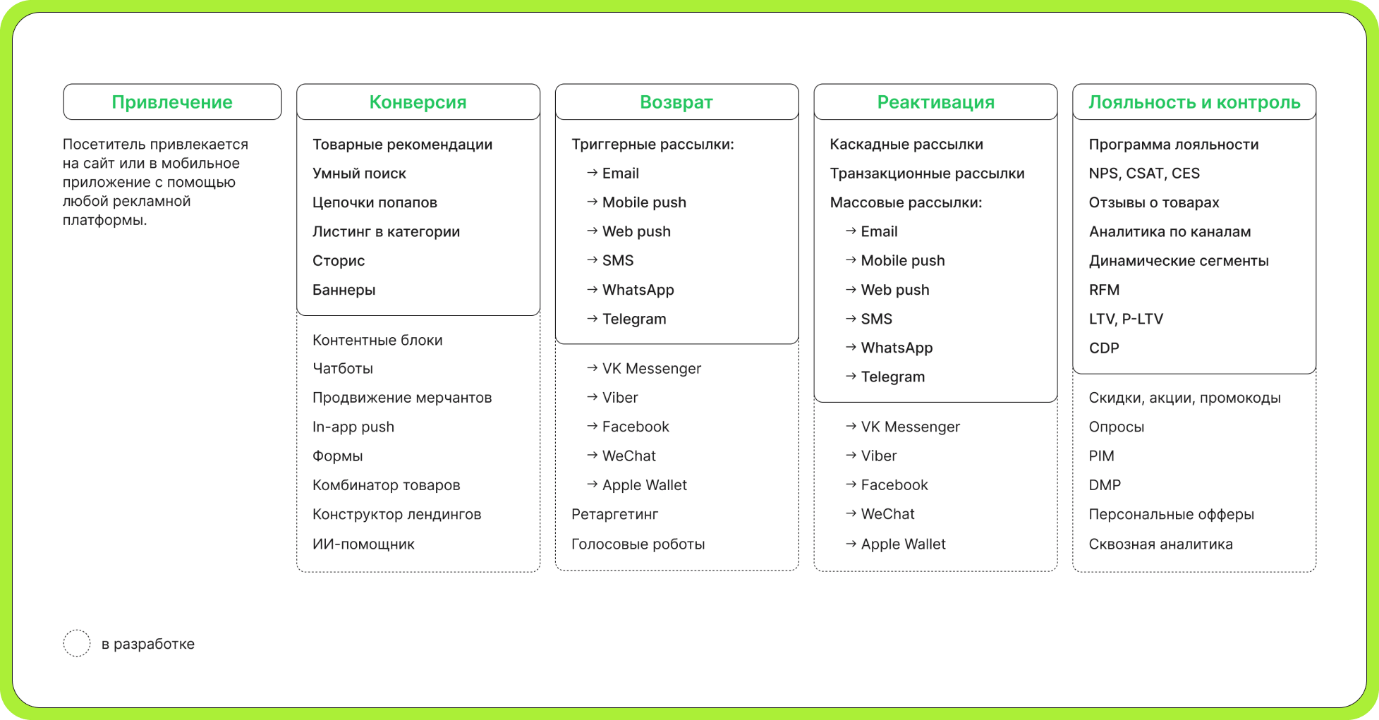
The first stage is conversion tools. Someone lands on your website or app, and we convince them to buy: product recommendations show relevant items, search helps them find what they came for faster, and we try to get them to subscribe or share their contact details in exchange for a discount.
The second stage is bringing visitors back. Someone has visited the site but left without buying; our tools help re-engage them with a relevant offer. This is where triggered messages come in: web push, mobile push, email, Telegram, WhatsApp, SMS and so on — you can connect any external service. In other words, if someone came by and we had some kind of contact with them, we can bring them back with an offer. We’ll soon launch a new feature here: automatic integration with ad platforms for retargeting. That way we’ll be able to bring back even people who didn’t leave any contact details.
The third stage is reactivation. We have an audience of customers with contact details; we segment them and send each segment its own offers. With the right segmentation and well-crafted offers, these tools can generate up to 30% in additional revenue.
And the fourth stage is loyalty and quality control: loyalty programs, reviews, NPS. The store collects customer feedback — did they like the product, was the courier polite, did the order arrive on time. The business processes these reviews and responds. If a review is negative, it’s important to address the problem, apologize, and rebuild the customer’s trust. If it’s positive, say thank you and send a gift. You can segment your audience by almost any criteria. Say someone has been looking at a certain brand for the past two weeks but hasn’t bought anything. We know they have two kids, a car and a dog, and live in St. Petersburg. We take those parameters, process them and make a unique offer. That’s how these tool groups work.
Can you predict how effective the tools will be depending on a company’s industry?
Yes, of course — but a lot depends on the tool and the integration. Choosing the right tool is key: product recommendations, product search, triggered emails or bulk emails. Tools perform differently across industries — and even regions. In Turkey, for example, bulk emails drive the biggest share of store revenue, while in Russia product search works best, because people come looking for something specific and we help them find it. And of course, it matters how marketers actually work with each tool.
For example, we have a recommended layout for product recommendation blocks: on the homepage, category pages, product pages and the “not found” page. Place recommendations across several pages and they’ll perform well: a 10–15% revenue lift, and in some cases up to 22%. But put a single block somewhere at the bottom of the homepage and, naturally, nobody will see it, click on it or buy anything. So a lot depends on how well the tool is integrated and how skilled the marketer is: do they run A/B tests, experiment with placement, even with block headlines?
Historical webinar reference — October 31, 2024. The interview promoted a webinar exploring this tool and its advanced use cases, including less familiar tactics and practical ways to improve conversion. The planned topics included how recommendation blocks work together with other tools, how hyper-personalization can improve margins, and case studies with real numbers. View the original webinar page.

Is irrelevant retargeting still a problem — you buy something, and ads for it follow you everywhere for months?
For now, yes. But you have to understand that some products you buy once every few years — screwdrivers, say — while others you buy regularly, like dog food. So there’s no point recommending more screwdrivers, but you should offer what the customer buys periodically. If they bought dog food today, then in two or three weeks it’s time to show them dog food again — and maybe some new products in that category.
We have all these tools, and we can configure them. In other words, we can tell the difference between pants you buy once a year and bread you buy every day.
What key metrics do you use to measure the effectiveness of product recommendations?
The main metric is money. Indirect metrics like pages per session and session duration matter for content projects and media outlets. For a store, it’s the exact opposite: the longer someone wanders around the site, the more likely it is that they can’t find what they need — and the higher the risk they’ll leave for a marketplace. So the single most important metric for product recommendations is how much revenue they bring in.
How do you balance artificial intelligence and human judgment when setting up and managing your tools?
That’s a very interesting topic. It’s important to understand that AI, machine learning, neural networks — they’re a black box you can’t trust blindly. You can’t just tell AI, “Show whatever you think is right on the homepage.” We once had a store switch to us from a competitor after the owner saw snow tubes in the homepage recommendations. Fair enough — the owner had looked at those tubes back in January. Except it was already May. We showed them how our platform helps avoid mistakes like that, and they came over to us.
AI works like this: the person likes it, the person was interested — let’s show it to them. But you need to factor in a lot of things — seasons, geography, climate zones, the need to promote high-margin products — and that’s where manual control of the product catalog matters.
Take an electronics store: iPhones attract a huge amount of interest — it’s a legendary product — but the store’s margin on them is minimal. The real profit comes from Android phones. So when someone is looking for a smartphone, it’s better to recommend Android phones, because that drives profit, not just views. Sometimes a 50,000-ruble Android phone generates more profit for the store than a 110,000-ruble iPhone. Our platform’s biggest competitive advantage is that every tool is fully configurable. You can set it and forget it — the tools will keep generating revenue either way. But you can also use all kinds of sliders, dials and switches so the store can solve the problems that matter to it.
Which features and settings matter most in categories such as fashion and electronics?
In fashion, it’s crucial to factor in gender, size and season. A man is unlikely to be interested in women’s sandals; if a woman visits, you can show her men’s shoes, but somewhere further down. We pick products the person can actually wear. While they browse, we analyze which sizes they choose and which filters they apply. Season and geography, of course, should be set manually.
In electronics, you need to understand how much a shopper is willing to spend in each category. If someone bought a 150,000-ruble iPhone, that doesn’t mean they’re ready to buy an expensive fridge. Maybe they took out a loan, pooled all their money and bought themselves an iPhone as a treat — and they shop for home appliances in the budget segment. That’s why price preferences in electronics have to be analyzed category by category. Brand loyalty also matters in electronics. We look at search data to see who likes which brands, and factor that in too: bought a coffee machine? Show them a coffee grinder from the same brand.
What trends do you see in marketing automation, and how is your company responding to them?
The main trend is hyper-personalization — personalization on small data. The moment someone lands on your website or app, you need to start personalizing based on their very first clicks. That’s the biggest challenge right now. Our company solved it a long time ago.
Everyone in the market is talking about how important a Customer Data Platform is. But really, CDP is just a new name for something that’s been around for a long time: a platform that collects data from different sources and merges it into a single profile.
Deeper marketing automation also requires your own sales channel: you need to build direct relationships with customers and use your own communication tools.
Marketplaces are a good source of incremental sales, but if you rely only on anonymous buyers you’ll never sell to a second time, you won’t last long.
The key principle is that the tools’ job is to help visitors find the right product as fast as possible and anticipate their needs. That’s what drives both conversion and average order value.
What changes do you expect in shopper behavior, and how will they shape the tools?
People want to find what they came for faster. They aren’t willing to wait, search or browse a hierarchy of product categories. Ten years ago, when on-site search wasn’t very good, people preferred to find what they needed through the catalog: open the category tree, set filters and browse. The share of those users has dropped sharply. Most shoppers now use search. And the faster they find their product, the more likely they are to become a customer. This behavioral trend is here to stay.
Another trend is the personal assistant — like having a sales associate in the store who helps you find the right product for your specific needs. That’s especially relevant for complex products: a water heater, an industrial radiator, a lawn mower or a laptop. Choosing products like these takes expert help. Ideally, the associate’s job is to help the customer find exactly what they need so they leave happy and come back. Personalization partly solves this: it analyzes the shopper’s interests and attributes and tries to find matching products. But again, it doesn’t solve the challenge of choosing complex products.
So when buying complex products, do you still have to go to a physical store and ask a sales associate?
You can ask AI. For example, to find the right water heater, AI asks guiding questions: how many people are in the household, the size of the room, ceiling height, how often you shower, and so on. Then it analyzes the data, matches it against the specs of available products and says: “These three water heaters will work for you.” That solves the online selection problem — and the shopper doesn’t have to compare hundreds of water heaters and decipher technical specs on their own.
I think by early 2025 our company will also have a new feature to help shoppers choose complex products.
Historical closing invitation. The original interview ended by inviting readers to the October 31, 2024 webinar for a demonstration of the tools available at that time. Original event page.
Valeria Mironova, Retail.ru
Advertisement. Personalizatsiya LLC, erid: LjN8K4haV